


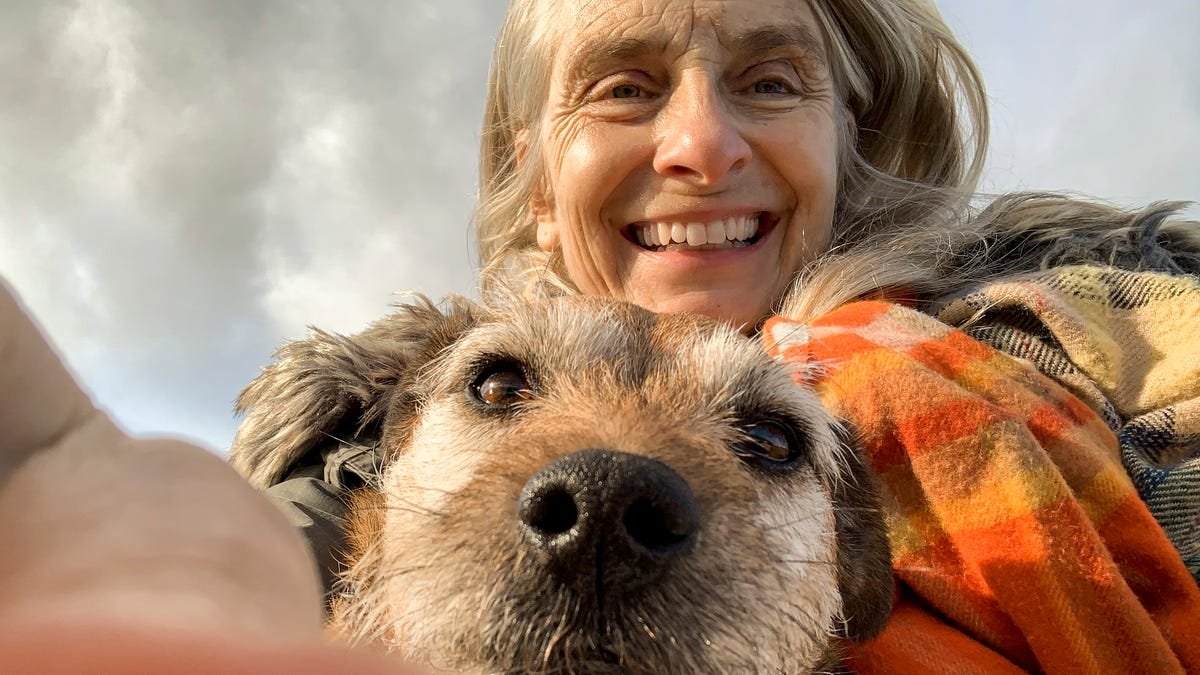
I remember the exact sound retirement made in my kitchen. The click of the coffee maker at 6:12 a.m. The soft shuffle of Beignet’s paws on the tile. WWNO murmuring like company that never asks you to explain yourself. For forty-three years, my mornings led somewhere. Then one morning, they simply… stayed.
Back when I worked at the East Bank Regional Library in Metairie, I could tell you what time the book drop would start clanging. I could tell you which regulars needed large print, which teen would ask for graphic novels and pretend it was for a cousin and which parent would “just browse” until the toddler lost a shoe. I carried the day like a laminated schedule. Retirement felt like somebody erased the whiteboard and left the marker cap off.
I retired February 1, 2021. I told myself I was ready. The house was paid off. The pension was steady. My 457(b) contributions had done their quiet work for years. Danny, my husband, joked that he’d finally get to see me in daylight. I smiled and said, “Let me think a minute,” like I always do when I am trying to stay calm on the outside.
The first month felt like a long weekend. The second month felt like a reward. By the third month, the air in the house changed. It was still the same 1987 brick ranch with storm shutters checked before hurricane season, same library tote bags on two hooks by the back door, same magnet clip holding three overlapping grocery lists. Yet something in me kept listening for a reason. A meeting. A shift. Somebody expecting my calm desk voice.
One Tuesday in late spring, I stood at the kitchen counter and cleaned it too thoroughly. I wiped the same spot until it squeaked. I lined up the mail, then lined it up again. I even caught myself re-shelving books by color at home, which is something no librarian should admit in public. The thing is, when your calendar goes quiet, your mind starts filling the space with little alarms.
That day, my phone stayed stubbornly still. No one needed an answer. No one needed a ride. No one needed a reminder. And I realized, with a small pinch of shame, that I had built my whole sense of belonging around being useful. I had the money security. I had the comfortable home. I had nowhere I needed to be and nobody who noticed whether I showed up.
1. Month three, when my calendar went quiet
Month three was when I stopped feeling like I was “on vacation” and started feeling like I had been quietly unassigned. I still woke at 6:12 a.m., out of habit. I still checked the weather app. I still did one local news scan. The coffee tasted the same, but my body did not know what to do with the day afterward.
One morning, I clipped Beignet’s leash and walked my usual loop at Lafreniere Park. The humidity was already creeping up, the kind I call soup weather. I sat on the same bench for the same pause, watching people power-walk in bright sneakers like their lives depended on it. I noticed a woman in scrubs talking on the phone, quick and clipped. I found myself thinking, with an odd little longing, “Somebody needs her.”
Here is what surprised me. I did not miss the stress of constant questions, the printer jams, the “Can you do this one thing right now?” that meant three things. I missed the shape of the day. I missed being woven into a place where my presence mattered in small, steady ways. You can love your home and still crave a world outside it.
When your calendar goes quiet, your brain does what brains do. It searches for meaning. It scans for threat. It tries to solve a problem. Mine turned to my old comfort, logistics. I started making lists that did not need to exist. I mapped out errands like a military plan. Dorignac’s on Wednesday. Gas on Veterans Memorial Boulevard. A quick loop by the Lake Pontchartrain levee path near Bonnabel Boat Launch, just to “check the water,” as if water requires supervision.
Years ago, at the library, I could handle a frantic day because it had edges. Open, lunch, afternoon rush, close. Retirement gave me wide-open hours and my mind filled them with a low-level itch. If you have ever stood in your own kitchen and wondered why you feel unsettled when nothing is wrong, you understand. Quiet can feel like freedom and it can feel like being left out.
By the end of that third month, I started noticing something else too. Danny would say, “Let’s take a road trip,” and my throat would tighten. He likes spur-of-the-moment plans and nicer dinners out. I like clear monthly numbers and a larger buffer. We were protecting the same life from different angles and I was also protecting myself from something I could barely name. I was protecting myself from the feeling that nobody needed me.
2. My old habit: I confuse useful with close
I admit it, I became a professional helper. Librarianship trained my brain to locate the right resource quickly. In my mind, the fastest path to safety was a good answer. Somebody comes to you worried, you hand them a map. Somebody comes to you overwhelmed, you point to the right form. It worked at the desk and I carried that habit home like a library tote bag I never set down.
Camille, my oldest, lives in Mid-City New Orleans. She wants direct emotional language. I tend to default to practical help and “did you eat?” texts. One evening she called, voice tight, talking about a hard week. I listened, then asked if she wanted me to bring groceries. There was a pause. She said, “Mama, I need you to say you’re with me.” My stomach dropped. I had offered a bag of oranges when she wanted my attention.
That moment stung and it also taught me something important. Many of us learned love as action. You cook. You fix. You organize. You show up with paper towels and a plan. Those things matter. They just do not cover everything a relationship needs. Closeness grows when you let someone’s feelings exist in the room with you, even when you cannot solve them.
My son Julian lives in Baton Rouge and our best conversations happen side-by-side doing tasks. He will call while he’s changing a light fixture or driving to Home Depot. He talks, I talk, nobody has to stare at the tender parts. This rhythm used to feel perfect to me. After retirement, I noticed I was using tasks as a shield. If I stayed in motion, I could avoid the quiet question underneath. “Do you miss me, or do you miss what I do?”
My youngest, Sophie, is in Houston Heights. She sends voice notes and photos, which gives me a low-pressure doorway for honesty. One day she sent a picture of Marco, my grandson, covered in spaghetti sauce, grinning like he invented joy. I almost replied with a joke and a tip for stain removal. Instead I sent a plain voice note: “That made me laugh out loud. I miss y’all.” My voice shook. I was surprised by how close that felt, like stepping into sunlight.
When you confuse useful with close, you can end up exhausted and lonely at the same time. You can be the person everyone calls for help and still feel invisible. That was my retirement lesson. My hands knew how to do a thousand things. My heart needed practice saying, I’m here, without adding a solution.
3. Why retirement can feel like losing your “place”
There was a time when I thought retirement would feel like relief. In some ways, it did. My knee, with its mild osteoarthritis and that old 2018 arthroscopy, appreciated fewer stairs. My shoulders appreciated fewer tense meetings. Still, losing work can feel like losing a role in the community and roles are a big part of how we recognize ourselves.
I remember my last months at East Bank Regional. I was Public Services Manager, which meant I wore calm like a uniform. When things got frantic, I lowered my voice. I could feel people settle. That feeling, being a steady point in a busy place, was part of my identity. Retirement took that away overnight. I became, in my own mind, a woman with a paid-off house and a lot of daylight. That sounds lovely and it can still feel hollow.
If you are in this stage of life, you might relate to how strange it is to go from being “needed” to being “available.” Availability looks like ease on paper. Inside, it can bring a sense of floating. Your brain likes a sense of place. It likes routines that confirm, “I belong somewhere.” Work gave that to me without me having to ask for it.
I saw this in small moments. At Dorignac’s, I used to run into former colleagues and patrons. We would talk about books, parish gossip and storm season. Once I retired, those encounters became less frequent. Even the familiar faces felt like they were attached to my old life, the life with a name badge. I still had my first Jefferson Parish Library badge in a small frame at home and I started looking at it the way you look at an old photo of yourself. Fond and a little far away.
My friend Renee Landry, a retired public school counselor, said something that stuck with me over coffee and beignets. “Your work gave you a steady mirror,” she said. “Now you have to choose new mirrors.” Renee always has a way of saying a truth without making it heavy. She ran meal drop-offs for two weeks after Danny’s hand surgery and she did it with the same calm competence she used in schools. She understands roles too.
Retirement can bring a quiet identity wobble, especially for people who found safety in being competent. If you spent decades being the reliable one, you might wonder what you offer when reliability is no longer scheduled. I started to see that my “place” was not a building. It was a pattern of connection. I could build it again, one small choice at a time.
4. The smallest kind of belonging, one repeated loop at a time
I took a walk in the Sydney and Walda Besthoff Sculpture Garden one afternoon with no plan and no timer. That detail matters, because I usually love a plan. The garden was quiet, filtered light through the oaks and the air smelled like damp leaves and distant rain. I sat on a bench, watching a couple point at a sculpture like it was a private joke. Nobody needed anything from me. I felt oddly safe.
Belonging often starts small. You return to the same place. You see the same faces. You become familiar to someone, even if you never learn their last name. At Lafreniere Park, there’s a man who walks a brindle pit mix at the same time I do. We nod. Sometimes we exchange a comment about the weather, because in Metairie we talk weather before we talk football. That nod became a tiny thread, a reminder that I exist in other people’s mornings too.
The thing is, many of us wait for belonging to arrive as an invitation. A big welcome. A group that says, “We’ve been waiting for you.” Adult life rarely works like that. You often build belonging through repetition. You become a regular. You show up enough times that your presence starts to register.
I noticed this when I went back to the East Bank Regional Library as a volunteer for adult literacy on Mondays. The building smelled the same, paper and carpet and a hint of copier toner. I felt my shoulders drop, like my body remembered how to be there. One learner asked me, shyly, how to pronounce a word. I heard my old calm desk voice come out. I did not feel heroic. I felt placed.
My neighbor, Dr. Marcus Bennett, is an internist at Ochsner and he is a trusted reality-check voice around my health anxiety. One evening, we chatted near the driveway while Angela Nguyen down the block watered her plants. I mentioned how restless I’d been since retiring. Dr. Bennett said, “Your nervous system liked the predictability.” He said it gently, like he was describing the weather. Predictability is a kind of medicine and you can dose it in small loops.
When you are building a new life rhythm, start with repeatable routines. A park loop. A volunteer shift. A Friday coffee at Cafe du Monde in City Park with one friend. I have that Friday ritual locked and it does more for my mood than any grand plan. Belonging can begin with showing up where someone expects to see your face.
5. The “show up” list I keep on my fridge
My fridge door is a working document. It has a magnet clip holding three overlapping grocery lists. It has a parish event flyer tucked under a wedding save-the-date that I keep forgetting to mail back. And it has, these days, a small index card with my “show up” list. I wrote it in the same handwriting I used for circulation notes, the kind that always ended up with coffee rings.
I started the list after a Sunday late afternoon family call window that felt strangely flat. The kids were fine. The grandkids were busy. Everyone was moving. I hung up and felt like I had watched my family through glass. So I asked myself a simple question. “Where can I show up in a way that feels real?” Then I wrote down the smallest answers.
My list has things like: Monday literacy shift. Wednesday Dorignac’s with one extra minute to chat. Friday coffee with Renee. One “Library Saturday” outing with a grandkid, phone stays in my bag except for one photo. It also includes a reminder that sounds silly until you need it: step outside before noon. Fresh air changes my thinking and I am old enough to admit that I require basic maintenance.
One week, I used the list with Theo, my loud, kinetic grandson whose feelings come at full volume. We did Library Saturday at East Bank Regional, then Storyland in City Park. He darted from statue to statue. I wanted to control the schedule. Instead, I followed him and practiced being present. When we got beignets, powdered sugar everywhere, he looked up and said, “You’re fun today.” That hit me in the chest, sweet and surprising.
Your own “show up” list will look different. The point is not to pack your week until you feel busy again. The point is to create a few anchors that give your days a sense of meaning. If retirement has made you feel invisible, your list becomes a gentle way to make yourself visible again, first to you, then to the people around you.
I keep my list short on purpose. If it gets too long, I start treating it like a performance review. I am learning to choose a handful of actions that lead to connection. Then I let the rest of the day be a day. That is harder than it sounds and it is also the most peaceful thing I have done in years.
6. A gentle script for reaching out without fixing
It took me a long time to realize how often I reach for advice when what I want is closeness. Advice keeps me on safe ground. Feelings feel slippery. If you grew up with “be helpful,” “do not complain,” “handle your part and keep moving,” you may have a similar reflex. You hand someone a solution and call it love.
I practiced a new script with Camille after one of our tense little moments. She had texted something heavy and my fingers hovered over the keyboard, ready to offer a plan. I set the phone down, took a breath, then picked it up again. I typed: “I hear you.” Then: “That is fair.” Then: “Do you want to vent, or do you want ideas?” She replied, “Vent.” I felt oddly relieved. The rules were clear.
Here’s what helped me. I started using a three-step pattern that feels natural enough to remember. First, reflect: “That sounds hard.” Second, offer presence: “I’m with you.” Third, ask permission: “Do you want my thoughts?” This keeps you from rushing into a fix. It also respects the other person’s autonomy, which adults appreciate more than we say out loud.
My friend Patricia Gomez, a former library colleague in Harahan, still meets me at East Bank Regional once a month “just to browse.” We walked the aisles like we were inspecting our old kingdom. I told her I felt embarrassed admitting I was lonely. Patricia said, “You spent decades being the answer lady. Of course it feels strange to ask.” We checked out novels, then sat in the parking lot and talked for thirty minutes. No advice. Just real talk.
With Sophie, the script looks like voice notes. I keep them short, because I tend to polish. One day I said, “I miss you. I’m proud of you. I’m thinking of you when I walk Beignet.” She sent back a photo of her coffee mug and wrote, “Miss you too, Mama.” That simple exchange was a small bridge. Bridges matter.
If you want a sentence you can borrow, here it is: “I don’t have a fix. I am here.” I said it to Camille once and it felt like taking off a heavy backpack. Your people often want your attention more than your strategy. The closer you get to that truth, the lighter your relationships start to feel.
7. Building two or three “we” places after work life
Years ago, I thought community was something you either had or did not have. Retirement taught me it is something you build through choices that repeat. Work provided a built-in “we.” The staff. The patrons. The routines. After retirement, I had to create new “we” places on purpose.
Danny and I reconnect best on walks where neither of us has to perform. He jokes when tense. I plan when tense. So we started doing a simple evening loop, sometimes around the neighborhood, sometimes along the levee by Lake Pontchartrain. We talk about small things first. A neighbor’s new roof. The price of shrimp. Whether the sky looks like rain. Then, without forcing it, deeper things show up.
A “we” place can be as basic as a regular table at a coffee shop. Friday coffee and beignets at Cafe du Monde in City Park with Renee gives me a steady touchpoint. We sit, we people-watch, we complain lightly about humidity. I leave feeling like I belong to a tiny weekly tradition. That does something to the nervous system. It also does something to the heart.
For me, another “we” place is St. Clement of Rome Parish events, even when I only know people in that light-touch way. Father Michael O’Connor has a talent for asking, “How are you really?” without making it feel like a spotlight. I do not always give him the full answer. Still, being in a room where people say hello and remember your name creates a sense of being held by community.
If you are building your own “we” places, keep the goal simple. You want two or three groups or routines where your absence would be noticed. That might be a walking group, a volunteer shift, a class, or a weekly phone call. The important part is consistency. Social connection grows through repeated contact and repeated contact is easier when it sits on your calendar like an appointment.
I used to think I had to earn my place by being indispensable. These days, I aim for something softer. I aim to be present enough that my life touches other lives in ordinary ways. A nod at the park. A shared joke at Cafe du Monde. A Monday morning learner who says, “See you next week.” That is a “we.” That is plenty.
8. When I ask for extra support and who I ask
My shame script is quick. “I should have called sooner.” “I said too much.” “I made this about logistics again.” When stress hits, I wake around 3:00 a.m. and run mental checklists, like my brain is trying to earn peace through effort. I used to handle those nights alone, because independence is one of my oldest habits.
One night, after a long stretch of restless sleep, I finally told Danny, “I’m feeling off.” He was in the living room, remote on the coaster, joking about some TV rerun. He looked at me like he was startled, then he softened. He said, “Come sit.” We sat in The Chair corner near the lamp and I let myself be quiet. No plan. No solution. Just shared air.
When I need extra support, I start with Renee because she checks in without drama. I can text her, “Can you talk?” and she answers like it’s normal, because it is. I also reach out to Patricia when I want someone who understands my library past and does not romanticize it. We can talk about purpose and also talk about which mystery series still holds up. That combination keeps me grounded.
I also lean on Dr. Marcus Bennett in a very specific way. I do not ask him to be my therapist and he does not act like one. I ask him for a reality check when my health anxiety gets loud, especially after those borderline blood pressure readings back in September 2024. He reminds me that daily walking, lower sodium and steady sleep habits matter. He says it like a neighbor, which helps me hear it.
If you are in retirement and you feel unsteady, asking for support can feel like admitting failure. I see it differently now. Asking for support is a form of showing up. You show up for your own well-being and you give other people the gift of being trusted. Many relationships deepen when you let yourself be known in a slightly messier way.
These days, when I feel that old urge to add one more errand to avoid sitting still, I pause at the back door where the tote bags hang. I clip Beignet’s leash. I step outside. I remind myself, quietly, we can do this one step at a time. The air is warm, the street is ordinary and my life is still here, waiting for me to enter it.
Note from Cottonwood Psychology:
At Cottonwood Psychology, we let real authors share their real-life stories and struggles and we explain how these psychological concepts affect us in daily life.
- Many people feel a shift in identity and belonging after leaving work, even when finances feel stable. In the Harvard Study of Adult Development, psychiatrist Robert Waldinger, MD highlights how strongly relationships influence well-being, saying, “The surprising finding is that our relationships and how happy we are in our relationships has a powerful influence on our health,” This supports the idea that retirement planning includes social and emotional planning. Harvard Gazette summary
- When Elodie builds small routines, like the same park loop or a weekly coffee, she is creating predictable touchpoints that help the mind and body feel settled. Predictability and repeated contact can lower the sense of “floating” that shows up when a calendar suddenly clears. Over time, tiny rituals become a structure for connection, which can support mood and resilience. U.S. Surgeon General’s Advisory on Social Connection
- The Surgeon General’s Advisory offers practical “micro-actions” that strengthen social connection, which matters when you are rebuilding your days. Dr. Vivek H. Murthy writes, “Answer that phone call from a friend. Make time to share a meal. Listen without the distraction of your phone.” Elodie’s simple choices, like sending a short voice note or sitting with someone without fixing, match these everyday actions. Advisory PDF
- Retirement can also bring positive growth in purpose for many people, especially when they re-engage with meaningful roles. In Psychological Science research using U.S. panel data, Ayse Yemiscigil, Nattavudh Powdthavee and Ashley V. Whillans report, “Results showed a sizable increase in purpose in life as an outcome of retirement.” This fits Elodie’s experience of rediscovering purpose through adult literacy volunteering and family traditions like “Library Saturday.” Psychological Science article (via PMC)
- Belonging often becomes stronger when a person has more than one group or role that feels like “us,” especially after leaving a central identity like work. In Frontiers in Psychology, Niklas K. Steffens, Jolanda Jetten, Catherine Haslam, Tegan Cruwys and S. Alexander Haslam found that “Retirees (N = 171) who had multiple social identities following… retirement report being… more satisfied with retirement, in better health…” Elodie’s “we places,” like volunteer shifts, parish events and weekly coffee, reflect this multi-identity buffer. Frontiers in Psychology article (via PMC)
- Many people who “confuse useful with close” rely on problem-solving to feel safe in relationships. A therapy-informed step is practicing permission-based support, reflecting feelings first, offering presence, then asking if advice is wanted. This strengthens emotional attunement and reduces the pressure to perform competence as a substitute for connection. Harvard relationships insight